



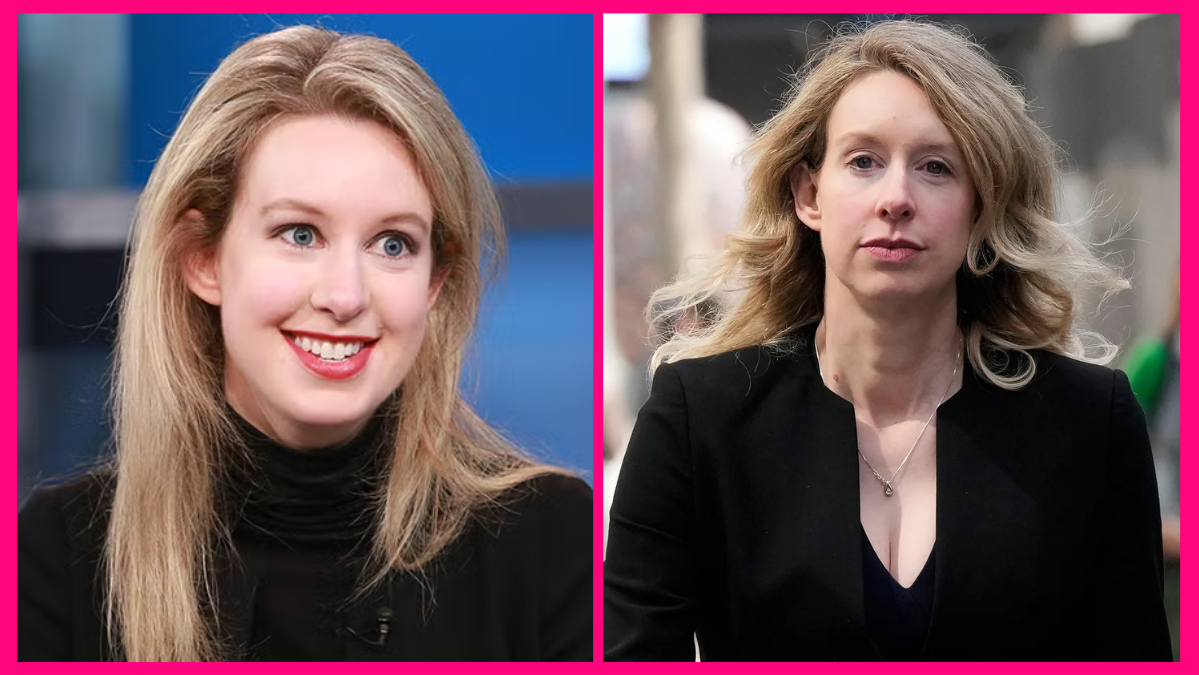
Elizabeth Holmes became one of the most recognizable names in Silicon Valley after founding Theranos, a healthcare technology company that promised to revolutionize blood testing. Her vision was simple but enormously ambitious: instead of requiring traditional blood draws and large laboratory machines, Theranos claimed that patients could receive a wide range of medical tests from a tiny amount of blood collected from a finger.
For a time, Holmes appeared to embody the image of the disruptive technology entrepreneur. She attracted wealthy investors, prominent political and business figures, and widespread media attention. Theranos eventually reached a reported valuation of approximately $9 billion at its peak, while Holmes herself became one of the youngest prominent female technology founders in the United States.
The story changed dramatically when investigative reporting and subsequent government investigations challenged the company’s claims about its technology. Theranos ultimately collapsed, Holmes faced federal criminal charges, and in January 2022 a jury convicted her of one count of conspiracy to commit wire fraud and three counts of wire fraud involving investors. The U.S. Department of Justice later reported that she was sentenced to 135 months, or 11 years and three months, in federal prison.
The Elizabeth Holmes story has since become a major case study in entrepreneurship, corporate governance, investor due diligence, healthcare regulation, media influence, and the dangers of allowing a compelling vision to move faster than scientific evidence.
Who Is Elizabeth Holmes?
Elizabeth Anne Holmes is an American former entrepreneur who founded Theranos in 2003. She established the company while she was still a teenager and a student at Stanford University. Her goal was to develop a new form of blood-testing technology that could make diagnostic testing faster, less expensive, and more accessible.
The concept appealed to a fundamental problem in healthcare. Traditional blood testing can require relatively large samples, specialized equipment, trained personnel, and laboratory processing. Holmes promoted the idea that Theranos could fundamentally simplify this process through proprietary technology.
Her public image became an important part of the company’s identity. Holmes frequently appeared in black clothing and spoke in a distinctive, confident style about changing healthcare. Her personal story, combined with Theranos’s ambitious mission, helped attract significant attention from investors and influential supporters.
However, the technology behind the company’s promises eventually came under intense scrutiny. Government records state that Theranos never perfected the blood-testing technology it promoted to investors.
Elizabeth Holmes Early Life and Education
Holmes was born in Washington, D.C., and grew up in Houston, Texas. She attended St. John’s School before enrolling at Stanford University. Her interest in technology and healthcare developed at an unusually young age, and she eventually became convinced that laboratory testing represented an opportunity for major innovation.
While studying chemical engineering at Stanford, Holmes became interested in creating a healthcare company that could make diagnostic testing more convenient. She left college before completing her degree and founded what eventually became Theranos.
Leaving Stanford was a major turning point. Rather than following a conventional academic or professional path, Holmes chose to pursue entrepreneurship full-time. The decision placed her in the center of Silicon Valley’s startup culture at a remarkably young age.
Her early success also demonstrated how powerful a compelling technological narrative could be. Investors were not simply being offered another software company. Theranos was presented as a business capable of changing the way millions of people interacted with healthcare.
The Founding of Theranos
Holmes founded Theranos in 2003, originally under a different company name. The company eventually became known as Theranos, a name associated with its combination of therapy and diagnosis.
The company’s central promise was revolutionary. Holmes said Theranos had developed proprietary devices that could perform numerous laboratory tests using only a very small amount of blood. Instead of traditional venous blood draws, the company promoted finger-stick collection as a more convenient alternative.
Theranos developed devices that were publicly associated with names such as Edison and later the proprietary technology platform often described as the company’s blood-testing system. Government evidence later described claims that the technology could deliver cheaper, faster, and more reliable results than conventional testing methods.
The promise was particularly attractive because blood testing is one of the most common components of modern medicine. If the technology had worked as advertised, it could potentially have affected hospitals, doctors, pharmacies, laboratories, and patients.
That enormous potential helped Theranos attract substantial investment and partnerships.
How Elizabeth Holmes Built the Theranos Image
A major part of Theranos’s rise involved the way Holmes presented both herself and the company. She positioned Theranos as a mission-driven healthcare organization rather than simply another technology startup.
Holmes frequently emphasized the company’s potential to improve patients’ lives. The company’s messaging suggested that medical testing could become more accessible and less intimidating, while the technology could potentially identify health problems earlier.
This vision resonated with investors who wanted to support a potentially transformative company. Theranos also benefited from the credibility of prominent individuals associated with its board and network.
According to the Department of Justice, prosecutors presented evidence that Holmes represented Theranos to investors as having been comprehensively validated by major pharmaceutical companies and suggested that the company’s Walgreens rollout would soon expand dramatically.
The distinction between an ambitious prediction and a misleading representation became central to the later criminal case.
Theranos and Its Billion-Dollar Valuation
At its height, Theranos was valued at roughly $9 billion. Holmes became a highly publicized symbol of Silicon Valley success, and the company’s valuation transformed her into a prominent technology entrepreneur.
The valuation was based largely on expectations about what Theranos could become. Investors believed the company possessed valuable proprietary technology and had the potential to disrupt the enormous medical diagnostics market.
This is an important feature of startup investing: companies can receive significant valuations before they become profitable or even before their products have reached widespread commercial adoption. Investors often place substantial weight on future potential.
In Theranos’s case, however, the gap between the company’s public claims and the actual capabilities of its technology eventually became the central issue.
What Went Wrong at Theranos?
The fundamental problem was that Theranos’s technology did not perform as broadly or reliably as the company had represented.
The company’s public narrative suggested that its proprietary systems could perform a large number of tests from tiny blood samples. But investigations raised serious questions about whether the devices could actually deliver accurate and dependable results at the scale promised.
The U.S. Department of Justice later stated that Holmes and others had promoted claims about Theranos’s ability to provide accurate, fast, reliable, and inexpensive blood-testing services despite problems with the technology.
This was particularly serious because healthcare testing is not merely a consumer technology issue. Incorrect laboratory results can potentially influence medical decisions, diagnoses, and treatment.
The controversy therefore extended beyond business ethics. It became a question of scientific reliability, patient safety, corporate responsibility, and the obligations of healthcare companies.
The Wall Street Journal Investigation
One of the most important turning points came in 2015, when The Wall Street Journal published investigative reporting that challenged Theranos’s claims.
The reporting raised questions about whether Theranos’s proprietary machines were actually being used for the large number of tests the company had claimed. It also brought attention to concerns from former employees and people familiar with the company’s laboratory operations.
The coverage attracted enormous public attention and triggered further scrutiny from regulators and investigators.
Once the company’s claims began receiving sustained external examination, Theranos faced increasing difficulty maintaining its previous public image. The controversy eventually contributed to the company’s collapse.
The Collapse of Theranos
As scrutiny intensified, Theranos’s business relationships and credibility deteriorated. The company faced investigations, regulatory problems, lawsuits, and increasing skepticism about its technology.
The Walgreens relationship became particularly important because the partnership had helped Theranos present its technology as commercially viable. But the rollout did not develop as the company had originally suggested.
The company’s financial and operational problems eventually became impossible to overcome. Theranos ceased operations in 2018.
The collapse represented a dramatic reversal from its earlier status as one of Silicon Valley’s most talked-about startups.
Elizabeth Holmes and Sunny Balwani
Ramesh “Sunny” Balwani was another central figure in the Theranos story. He served as a senior executive at the company and was romantically involved with Holmes for a period of time.
Holmes and Balwani were ultimately prosecuted separately. Their trials produced different outcomes, although both were convicted of federal offenses connected to Theranos.
Holmes’s case focused on investor fraud charges, while Balwani was convicted on all counts brought against him in his separate trial. The Department of Justice reported that Balwani received a 155-month prison sentence.
Their relationship and respective roles became important subjects in documentaries, books, podcasts, and dramatizations about Theranos.
The Federal Criminal Case Against Elizabeth Holmes
Federal prosecutors charged Holmes in 2018 with fraud-related offenses associated with Theranos.
The case eventually went to trial in 2021. Holmes pleaded not guilty and testified in her own defense during the proceedings.
The trial lasted approximately four months and involved extensive documentary evidence and testimony from numerous witnesses. The prosecution argued that Holmes knowingly misrepresented important aspects of Theranos’s technology and business prospects to investors.
The defense disputed the government’s characterization of Holmes’s conduct and sought to place responsibility on other factors and individuals within Theranos.
Ultimately, the jury reached a mixed verdict.
What Was Elizabeth Holmes Convicted Of?
On January 3, 2022, a federal jury convicted Holmes of four charges: one count of conspiracy to commit wire fraud against Theranos investors and three counts of wire fraud involving individual investors.
The Department of Justice stated that the investor-related wire transfers involved more than $140 million.
However, the verdict did not find Holmes guilty on every charge brought against her. The jury acquitted her of the patient-related conspiracy charge and three patient-related wire-fraud counts. It also failed to reach unanimous verdicts on several other investor-related counts.
This distinction is important when discussing the case. Holmes was convicted of defrauding investors, but she was not convicted of the patient-fraud charges included in the indictment.
Elizabeth Holmes Sentencing and Prison Sentence
In November 2022, U.S. District Judge Edward Davila sentenced Holmes to 135 months in federal prison, equivalent to 11 years and three months.
The court also imposed three years of supervised release after her prison term. The Department of Justice reported that Holmes was ordered to surrender to begin her sentence in April 2023.
Holmes ultimately reported to federal prison in May 2023. Her imprisonment marked the end of one of the most extraordinary rises and falls in recent American business history.
As of 2026, Holmes remains incarcerated at a federal prison camp in Bryan, Texas, according to recent reporting.
Elizabeth Holmes Restitution and Legal Consequences
The financial consequences of the Theranos case extended beyond imprisonment.
In May 2023, the court ordered Holmes and Balwani to be jointly and severally liable for approximately $452 million in restitution to 12 Theranos investors. A 2026 Department of Health and Human Services decision confirmed that restitution figure.
Holmes also faced consequences within the healthcare sector. The Department of Health and Human Services Office of Inspector General announced in 2024 that she was excluded from participation in federal healthcare programs for 90 years based on her conviction.
That exclusion illustrates the broader impact of the case. The consequences were not limited to the criminal justice system; they also affected Holmes’s ability to participate in federally funded healthcare programs.
The Scientific and Ethical Lessons of Theranos
The Theranos scandal became a powerful example of why scientific claims require independent validation.
In technology startups, entrepreneurs are often encouraged to think boldly and challenge established industries. Ambition itself is not a problem. The difficulty arises when claims about a product move beyond what the underlying evidence can support.
Healthcare technology requires particularly rigorous standards because the consequences of failure can be serious. A software application that crashes is inconvenient. A medical test that produces unreliable information can potentially influence real medical decisions.
Theranos demonstrated the importance of transparent testing, peer review, regulatory oversight, independent verification, and strong internal governance.
It also highlighted the responsibility of boards and investors to ask difficult questions rather than relying solely on a founder’s confidence or reputation.
Elizabeth Holmes and the Culture of Silicon Valley
The rise of Holmes also prompted broader discussions about Silicon Valley’s startup culture.
Technology entrepreneurs are often celebrated for having extraordinary confidence and refusing to accept conventional limitations. That mentality can generate genuine innovation, but it can also create an environment in which skepticism is sometimes treated as resistance to progress.
The Theranos story became a cautionary example of what can happen when a powerful narrative becomes more influential than independently verifiable evidence.
Investors, journalists, employees, regulators, and customers all play roles in challenging ambitious claims. A healthy innovation ecosystem requires both optimism and skepticism.
The Media Portrayal of Elizabeth Holmes
Holmes’s story has generated extensive media coverage and several major adaptations.
The 2019 HBO documentary The Inventor: Out for Blood in Silicon Valley examined the Theranos scandal and Holmes’s public image. The Hulu miniseries The Dropout, released in 2022, dramatized the rise and collapse of Theranos, with Amanda Seyfried portraying Holmes.
Her story has continued to attract attention years after the collapse of Theranos. In 2026, a new documentary titled You Can See Everything, directed by Nathan Fielder and Lance Oppenheim, brought renewed attention to Holmes and her life around the period leading up to her imprisonment. Recent reporting says the film is scheduled for an October release.
The continued interest demonstrates how unusual the Theranos story remains in the history of modern entrepreneurship.
Elizabeth Holmes Family and Personal Life
Holmes’s personal life has received significant attention because her public career and legal troubles unfolded alongside major changes in her family life.
She married hotel heir Billy Evans, and the couple have children. Holmes was pregnant during the period surrounding her criminal trial, a fact that received considerable media attention.
Her family circumstances also became part of the public discussion surrounding her imprisonment. Recent reporting on the 2026 documentary describes Holmes’s family life and her reflections on separation from her children while serving her sentence.
Despite the enormous public interest in her life, Holmes has generally remained a complicated and controversial figure whose personal story cannot easily be separated from the Theranos case.
What Happened to Theranos?
Theranos ultimately shut down after years of controversy, regulatory action, lawsuits, and financial difficulties.
The company had once been presented as a potentially transformative healthcare business, but its failure demonstrated how quickly confidence can disappear when the core technology does not live up to expectations.
Theranos’s collapse also affected employees, investors, business partners, and patients who interacted with the company’s testing services.
The company no longer operates, but its name remains widely recognized because the case became an unusually prominent example of corporate and entrepreneurial failure.
Elizabeth Holmes Net Worth and Financial Status
Questions about Elizabeth Holmes’s net worth remain common because she was once widely described as a billionaire on paper.
However, estimates of her wealth during Theranos’s peak reflected the company’s private valuation rather than a straightforward amount of cash or liquid assets held by Holmes. Private-company valuations can change dramatically and do not necessarily represent money that an individual can freely access.
After Theranos collapsed, Holmes’s financial position changed substantially. Her legal obligations, restitution, and the company’s failure made earlier estimates of her wealth misleading.
For that reason, there is no reliable basis for treating the billionaire estimates associated with the height of Theranos as a reflection of her current personal wealth.
The Biggest Lessons From the Elizabeth Holmes Story
The Theranos case offers several important lessons for entrepreneurs, investors, healthcare companies, and consumers.
The first is that a compelling mission cannot substitute for validated technology. Holmes’s vision was attractive because it addressed a genuine problem, but the technology needed to work reliably before the promises could be responsibly made.
The second lesson concerns independent verification. Investors and business partners should not rely exclusively on information supplied by company leadership when evaluating highly technical claims.
The third lesson is the importance of corporate governance. Boards need members with the expertise and independence necessary to challenge executives, especially when companies operate in highly regulated industries.
Finally, the case demonstrates that reputation can be powerful but fragile. Holmes’s public image helped Theranos attract attention and investment, but once the underlying claims were challenged, the same public visibility contributed to the scale of the company’s downfall.
Elizabeth Holmes’s Legacy
Elizabeth Holmes’s legacy is complicated. She will likely be remembered both as a young entrepreneur who promised to transform healthcare and as the founder of a company whose claims led to a landmark fraud case.
Her story has become a reference point in discussions about startup culture, investor psychology, healthcare innovation, corporate ethics, and the responsibilities of business leaders.
The legal record is also clear about an important distinction: Holmes was convicted of investor-related conspiracy and wire fraud, while the jury acquitted her of several patient-related charges and did not reach verdicts on some other counts.
In that sense, the Theranos case is more than a story about one failed company. It is a broader lesson about the importance of evidence, transparency, accountability, and independent scrutiny when technological promises involve people’s money or health.
Frequently Asked Questions About Elizabeth Holmes
Who is Elizabeth Holmes?
Elizabeth Holmes is the founder and former CEO of Theranos, a healthcare technology company that claimed it could revolutionize blood testing. She was later convicted of investor-related wire fraud and conspiracy charges connected to Theranos.
What happened to Elizabeth Holmes?
Holmes was convicted in January 2022 of one count of conspiracy to commit wire fraud and three counts of wire fraud involving investors. She was sentenced to 135 months in federal prison and began serving her sentence in 2023.
What was Theranos supposed to do?
Theranos claimed that its proprietary technology could perform numerous blood tests using very small blood samples. The company promoted the technology as faster, cheaper, and more convenient than conventional laboratory testing.
Is Elizabeth Holmes still in prison?
Yes. Recent 2026 reporting says Holmes remains incarcerated at Federal Prison Camp Bryan in Texas while serving her federal sentence.
How long is Elizabeth Holmes’s prison sentence?
Holmes received a sentence of 135 months, or 11 years and three months, in federal prison, followed by three years of supervised release.
What is Elizabeth Holmes’s legacy?
Holmes is now widely associated with the Theranos scandal and is frequently discussed as a cautionary example of the risks of unchecked entrepreneurial claims. Her case has also influenced conversations about scientific validation, corporate governance, healthcare regulation, investor due diligence, and startup culture.
Final Thoughts on Elizabeth Holmes
The story of Elizabeth Holmes remains one of the most remarkable cautionary tales in modern business. Theranos began with a compelling idea: make medical testing simpler, faster, and more accessible. That vision attracted extraordinary attention and investment, but the company’s technological claims ultimately failed to withstand scrutiny.
Holmes’s conviction, imprisonment, restitution obligations, and exclusion from federal healthcare programs represent the serious consequences that followed.
At the same time, the story offers lessons that extend far beyond one entrepreneur. Innovation requires evidence, particularly when technology directly affects healthcare. Investors need to investigate ambitious claims. Boards need appropriate expertise and independence. And consumers need confidence that medical technologies have been properly validated.
That combination of extraordinary ambition, rapid success, investigative scrutiny, corporate collapse, and criminal prosecution is why the Elizabeth Holmes story continues to attract attention more than a decade after Theranos reached its peak.
Read also Katie Taylor Husband: Who Is Sean McCavanagh and What We Know About Their Marriage?
