



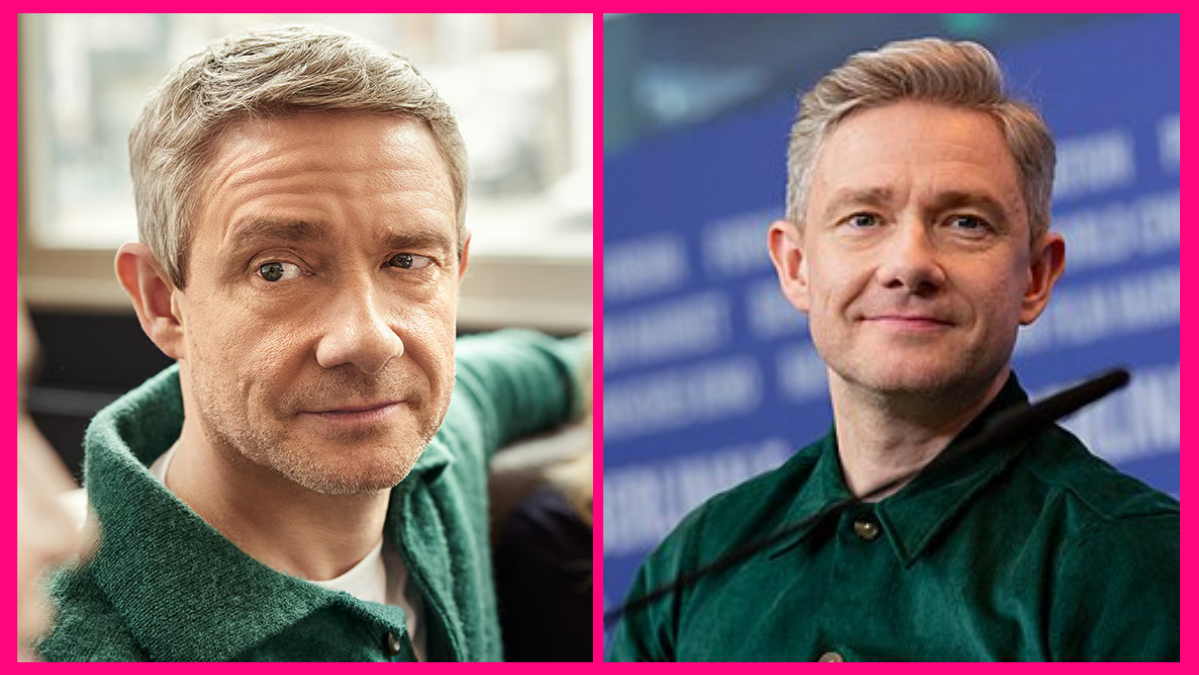
martin freeman has built one of the most distinctive careers in modern British screen acting. Rather than relying on a single type of role, he has moved comfortably between understated comedy, detective drama, fantasy adventure, dark crime stories, and emotionally complicated character pieces. That range is a major reason audiences continue to recognize his work even when he disappears almost completely into a character.
Born in Aldershot, Hampshire, on September 8, 1971, Freeman trained at the Central School of Speech and Drama before developing a career that steadily expanded from British television into international film and prestige drama. His breakthrough as Tim Canterbury in The Office gave him a reputation for dry humor and believable vulnerability, while later performances in Sherlock and The Hobbit transformed him into a global star. The Guardian has described the quality that made him so effective as an “endearing low-level grumpiness,” a phrase that captures his ability to make ordinary characters fascinating.
Early life and the path toward acting
Growing up in Hampshire, Freeman was the youngest of five children. His early life did not resemble the traditional story of a young performer being groomed for stardom. He eventually studied at the Central School of Speech and Drama in London, where he developed the practical skills that would become central to his career. That training helped him approach acting as a craft rather than simply as a route to celebrity.
His early professional work included appearances across British television and film, allowing him to build experience before becoming widely recognizable. This gradual development matters when looking at his career because his later success was not an overnight phenomenon. By the time major opportunities arrived, he had already learned how to create believable characters through small gestures, timing, pauses, and changes in tone.
The Office and the breakthrough as Tim Canterbury
For many British viewers, Martin Freeman became familiar through The Office, the influential BBC comedy created by Ricky Gervais and Stephen Merchant. As Tim Canterbury, he played a salesman trapped in an uninspiring workplace while quietly carrying an emotional attachment to Dawn Tinsley. The character’s appeal came from restraint. Tim was funny without behaving like a traditional sitcom comedian, and his reactions often said more than his dialogue.
The role also established a performance style that would remain useful throughout his career. Freeman could communicate irritation, affection, embarrassment, frustration, and hope without exaggerating any of them. His chemistry with Lucy Davis became one of the emotional anchors of the series, and Tim’s understated personality made the romantic storyline feel unusually grounded. The Guardian later noted that the role helped define his public image as an ordinary, slightly grouchy man-next-door.
The success of The Office opened doors into feature films, including Love Actually, The Hitchhiker’s Guide to the Galaxy, and other projects that showed he could move beyond television comedy. Importantly, he did not abandon comedy when dramatic opportunities appeared. Instead, he carried the same attention to character into very different genres.
Sherlock and the transformation into John Watson
Sherlock became one of the defining television projects of Freeman’s career. In the BBC series created by Steven Moffat and Mark Gatiss, he played Dr. John Watson opposite Benedict Cumberbatch’s Sherlock Holmes. The modern setting required the familiar literary character to feel contemporary, independent, and emotionally credible, and Freeman’s performance gave Watson an intensity that went well beyond the traditional image of the loyal sidekick.
His Watson is intelligent, observant, stubborn, funny, and capable of real anger. That complexity is important because Sherlock frequently places him in situations where loyalty conflicts with common sense. Freeman does not play Watson as someone simply impressed by Holmes. Instead, he creates a believable friendship in which admiration, irritation, affection, and moral disagreement constantly coexist.
Freeman has explained his approach to acting in terms of humanity rather than judging characters from the outside. In a CBS interview, he said, “My thing always is play people with some humanity. Because every single person has it.” That philosophy helps explain why his Watson feels like a person rather than a collection of plot functions.
The role earned Freeman a BAFTA Television Award for Best Supporting Actor and brought him a huge international audience. His chemistry with Cumberbatch became one of the show’s most discussed strengths. BAFTA later recorded Freeman describing their on-screen connection as something that simply “worked,” attributing the result partly to good fortune and chemistry.
Becoming Bilbo Baggins in The Hobbit
One of the most important turning points in Freeman’s film career came when Peter Jackson cast him as Bilbo Baggins in The Hobbit trilogy. The role was demanding because Bilbo begins as a comfortable homebody and gradually becomes a courageous adventurer. Freeman had to preserve the character’s humor and ordinary nature while making his transformation emotionally convincing.
The casting itself became part of the story. Jackson had wanted Freeman for Bilbo, but the actor’s commitment to Sherlock created a scheduling conflict. Production was adjusted so he could fulfill both commitments, an unusual solution that ultimately allowed him to appear in both projects. The Guardian reported that Jackson regarded Freeman as the only person they wanted for the role, emphasizing his combination of dramatic ability and comic timing.
As Bilbo, Freeman brought a particularly human quality to Middle-earth. His character is frightened, curious, stubborn, compassionate, and occasionally selfish. Those contradictions make the journey feel personal. The performance also demonstrates one of his most valuable strengths: he can make an extraordinary fictional world feel believable by reacting to it like an ordinary person.
Freeman himself has spoken about the freedom he found in performance. In an interview about The Hobbit, he explained that acting can be frightening because it is vulnerable, but he also emphasized the importance of giving himself permission to “play and to mess up.” That attitude helps explain the liveliness of his best performances.
Fargo and the darker side of his acting range
Fargo offered another major shift. In the television anthology’s first season, Freeman played Lester Nygaard, a mild-mannered insurance salesman whose life changes after an encounter with Lorne Malvo, played by Billy Bob Thornton. The character initially appears familiar to anyone who knows Freeman’s reputation for playing decent or ordinary men. The difference is that Lester’s story gradually reveals a much uglier side.
This was a smart use of audience expectations. Freeman’s established screen persona made Lester’s transformation more disturbing because viewers already trusted the actor’s ability to communicate vulnerability. The performance demonstrates that his range is not simply about moving from comedy to drama. It is about taking familiar qualities and turning them in unexpected directions.
In discussing Fargo, Freeman rejected the idea of simply reproducing the Coen brothers’ film. He said he had “no interest in being in just a TV version of the film,” explaining that the series needed its own identity. That comment reflects his broader approach to choosing projects: recognizable material can be valuable, but only when there is something fresh to explore.
Major movies beyond Middle-earth
Freeman’s filmography extends well beyond The Hobbit. His credits include Love Actually, The Hitchhiker’s Guide to the Galaxy, Nativity!, The World’s End, Whiskey Tango Foxtrot, Captain America: Civil War, Black Panther, and The Operative. These projects show how naturally he moves between ensemble comedy, science fiction, superhero cinema, political drama, and independent-style character work.
His appearances in the Marvel universe are particularly notable because they introduced him to audiences who might not have followed British television. In Captain America: Civil War, he played Everett K. Ross, a government official whose dry manner provided a different kind of energy within the larger superhero narrative. He later returned to the role in Black Panther, where his understated delivery contrasted with the heightened style of Wakanda.
The World’s End also allowed him to return to a more recognizably British comic mode, while other projects gave him opportunities to explore tension and seriousness. Across these roles, the consistent thread is not a particular accent, costume, or genre. It is his ability to make characters seem internally occupied, as though something is happening behind the words.
Acting style and what makes his performances distinctive
A major strength of Martin Freeman’s acting is his control of small reactions. He often lets a pause, glance, facial movement, or change in rhythm carry information that another performer might express through dialogue. This is particularly effective in stories where characters are surrounded by stronger personalities.
His performances also tend to avoid simple emotional labels. A character can be angry and amused at the same time, frightened while pretending to be confident, or affectionate while visibly irritated. Freeman has said that he dislikes two-dimensional acting and that he does not see people as simply angry, happy, or sad. That philosophy is visible in characters such as Watson, Bilbo, Lester, and Tim.
Another defining feature is his dry comic timing. Even in serious scenes, he can create humor without breaking the reality of the moment. That quality is one reason his dramatic performances rarely feel overly solemn. He understands that ordinary people can be funny in stressful situations, and that humor can reveal character rather than merely provide a joke.
Personal life, privacy, and public image
Freeman has generally been protective of his private life, particularly compared with many celebrities whose personal relationships become part of their public identity. His long relationship with actor Amanda Abbington was also connected to his professional life, as the pair worked together on projects including Sherlock. They have two children.
His approach to fame has remained relatively grounded. The contrast between global recognition and his screen image is interesting: he has played famous literary heroes, detectives, superheroes, and morally compromised characters while often maintaining the feel of an ordinary British actor who simply happens to have an extraordinary résumé.
That balance may help explain his longevity. He does not appear dependent on one franchise or one persona. When audiences associate him with Tim Canterbury, John Watson, Bilbo Baggins, or Lester Nygaard, they are remembering different sides of the same performer.
Awards, recognition, and career achievements
Over the course of his career, Freeman has received significant critical recognition. His BAFTA Television Award for Sherlock remains one of the clearest markers of his impact on British television, while his international film work has placed him in some of the biggest productions of the modern era.
His career is especially impressive because the projects that established him were so different. The Office was built around awkward workplace comedy. Sherlock was a fast-paced detective drama. The Hobbit was a major fantasy trilogy. Fargo was a dark crime story. Marvel productions placed him inside a massive shared cinematic universe. Few actors can move through those worlds without losing their individual identity.
The result is a filmography that works almost like a map of contemporary popular entertainment. Freeman has participated in acclaimed television, blockbuster cinema, British comedy, fantasy adventure, crime drama, and character-driven storytelling.
Martin Freeman’s most memorable roles
The enduring appeal of Martin Freeman lies in how differently his best-known characters use similar acting strengths. Tim Canterbury is restrained and hopeful. John Watson is loyal but combative. Bilbo is cautious yet increasingly brave. Lester is ordinary on the surface and deeply compromised underneath. Everett Ross is dry and pragmatic within an extraordinary world.
These roles also demonstrate how an actor can build a recognizable identity without repeating the same performance. Freeman’s characters often feel intelligent, observant, and slightly uncomfortable with their surroundings, but their motivations and moral choices can be completely different.
For viewers exploring his work for the first time, the strongest introduction is arguably to watch across several genres rather than concentrating on one franchise. Seeing The Office alongside Sherlock and The Hobbit makes his range immediately apparent. Adding Fargo reveals an even darker dimension, while films such as The World’s End and Black Panther show how comfortably he can shift tone.
The lasting legacy of a versatile British actor
The legacy of Martin Freeman is not based on a single iconic role, even though several of his characters have become cultural touchstones. His greater achievement is the consistency with which he has made complicated people feel natural. Whether the setting is a paper company in Slough, modern-day London, Middle-earth, or a bleak American town, he gives his characters a recognizable emotional life.
His career also illustrates the value of gradual development. The journey from British comedy performer to international film star did not require him to discard his earlier identity. Instead, he expanded it. The qualities that made Tim Canterbury appealing—timing, restraint, vulnerability, and dry observation—became tools that could be adapted to much more demanding roles.
That is why his work remains so easy to revisit. A strong performance does not depend entirely on knowing the plot. It works because the character seems to exist beyond the scene. Freeman has repeatedly shown an ability to create that sense of life, making even fantastical or heightened stories feel grounded.
Frequently asked questions about his career
What is Martin Freeman best known for?
Martin Freeman is best known for playing Tim Canterbury in The Office, Dr. John Watson in Sherlock, and Bilbo Baggins in The Hobbit trilogy. He is also widely recognized for Fargo, Marvel films, and a broad range of British and international productions.
These roles highlight the unusual breadth of his career. He can move from understated comedy to intense drama without losing the naturalistic quality that has become a signature of his acting.
When was Martin Freeman born?
Martin Freeman was born on September 8, 1971, in Aldershot, Hampshire, England. He later studied at the Central School of Speech and Drama in London before developing a career across television, film, and theatre.
His Hampshire background and British drama training became part of the foundation for a career that eventually reached major international productions.
Did Martin Freeman play Bilbo Baggins?
Yes. Martin Freeman played Bilbo Baggins in Peter Jackson’s The Hobbit trilogy, consisting of An Unexpected Journey, The Desolation of Smaug, and The Battle of the Five Armies.
His performance focused on Bilbo’s gradual transformation from a comfortable, reluctant homebody into a resourceful and courageous adventurer. The role became one of the defining achievements of his film career.
Did Martin Freeman win an award for Sherlock?
Yes. He won the BAFTA Television Award for Best Supporting Actor for his performance as John Watson in Sherlock. His work opposite Benedict Cumberbatch was widely praised for giving Watson emotional depth and independence.
The performance also helped establish him as a major international television actor, expanding the recognition he had already earned through British comedy.
What makes Martin Freeman’s acting style distinctive?
His style is often built around subtle reactions, dry humor, naturalistic dialogue, and emotional complexity. He can communicate a character’s inner conflict without relying on exaggerated gestures or speeches.
That restraint allows him to play both ordinary and extraordinary people convincingly. It is also why his performances can feel intimate even inside large-scale productions.
What are some of Martin Freeman’s most important movies?
Important films in his career include The Hitchhiker’s Guide to the Galaxy, Love Actually, The Hobbit trilogy, The World’s End, Captain America: Civil War, Black Panther, and other drama and comedy projects.
His movie career demonstrates considerable genre flexibility. He has worked in fantasy, romantic comedy, science fiction, superhero cinema, dark comedy, and serious drama while maintaining a distinctive screen presence.
Career snapshot
| Category | Key details |
|---|---|
| Full name | Martin John Christopher Freeman |
| Born | September 8, 1971 |
| Birthplace | Aldershot, Hampshire, England |
| Education | Central School of Speech and Drama |
| Breakthrough role | Tim Canterbury in The Office |
| Major television role | John Watson in Sherlock |
| Major fantasy role | Bilbo Baggins in The Hobbit trilogy |
| Notable dark-drama role | Lester Nygaard in Fargo |
| Marvel role | Everett K. Ross |
| Major television honor | BAFTA Television Award for Best Supporting Actor |
Conclusion
Martin Freeman has built a career defined by range, restraint, and an unusually strong understanding of human behavior. From the awkward charm of The Office to the emotional intensity of Sherlock, the adventure of The Hobbit, and the darkness of Fargo, his performances have repeatedly shown that subtle acting can be just as powerful as theatrical display.
What makes his career especially compelling is the way each major role adds another dimension rather than replacing what came before. He remains capable of comedy while taking on serious dramatic material, and he can appear in enormous franchises without losing the grounded quality that first made audiences connect with him.
For anyone interested in British actors, modern television, fantasy cinema, or character-driven performances, his body of work offers an unusually rich viewing journey. His most memorable characters may inhabit very different worlds, but they share a convincing sense of humanity—and that may be the most enduring achievement of his career.
Read also Gladys Knight: The Enduring Voice of Soul, Gospel, and R&B
