



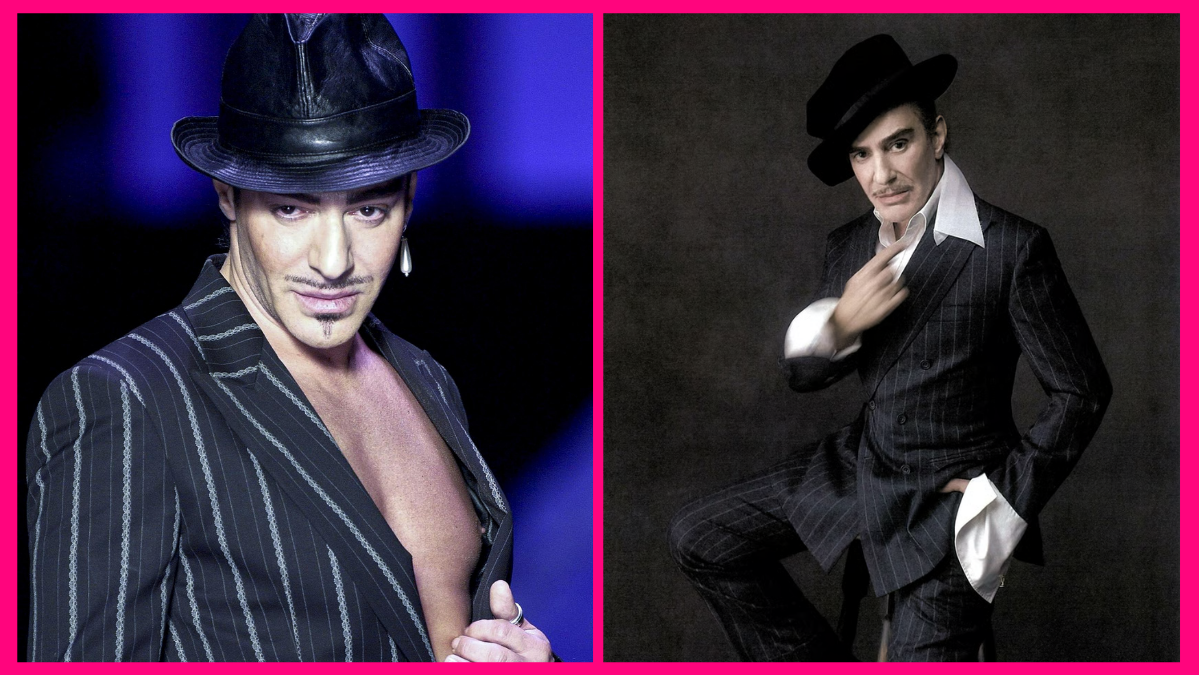
John Galliano is one of the most influential and controversial designers in modern fashion. Known for theatrical couture, historical references, extraordinary craftsmanship, and storytelling on the runway, he has spent decades pushing luxury fashion beyond conventional boundaries. From his early days in London to leading some of the world’s most prestigious fashion houses, his career has been defined by spectacular creative achievements as well as a deeply troubling personal controversy that changed the course of his life.
Born in Gibraltar in 1960 and raised in South London, Galliano developed an interest in clothing and visual storytelling at an early age. His education at Central Saint Martins in London gave him the technical foundation and creative freedom that would eventually make him one of Britain’s most recognizable fashion exports. His graduate collection, inspired by the French Revolution, immediately attracted attention and was famously purchased in its entirety by the influential London boutique Browns.
What makes John Galliano particularly fascinating is the contrast between his public image and his design philosophy. He has always approached fashion as something larger than clothing. His collections often create entire worlds, complete with characters, historical references, theatrical settings, music, makeup, and elaborate narratives. At his strongest, he does not simply design garments; he creates visual experiences that remain memorable long after a show has ended.
The Early Life and Education That Shaped His Vision
Galliano was born John Charles Galliano on November 28, 1960, in Gibraltar. His father was a plumber of Italian descent, while his mother had Spanish heritage. When he was young, the family moved to London, where he grew up in the relatively modest surroundings of South London. That environment was far removed from the glamorous world of Parisian haute couture, but it gave him a distinctive perspective that later became central to his work.
His education at Central Saint Martins was a major turning point. During the early 1980s, the London art and fashion scene was becoming increasingly experimental, and the school provided a perfect environment for a young designer with a taste for drama. Galliano’s 1984 graduation collection, “Les Incroyables,” drew heavily on the French Revolution and demonstrated his fascination with history, costume, and theatrical transformation.
The collection attracted considerable attention because it showed a designer who understood clothing as performance. Instead of simply presenting attractive garments, Galliano created characters and narratives. That approach became one of the defining characteristics of his career.
His early success also demonstrated an ability to combine meticulous tailoring with flamboyant imagination. British fashion critics recognized that he possessed something unusual: the technical discipline of a traditional couturier combined with the instinct of a theatrical director.
Building a Name in British Fashion
After graduating, Galliano established his own label and quickly became part of the generation of British designers transforming London’s fashion identity. During the 1980s, his collections gained attention for their extravagant silhouettes, historical inspiration, bias-cut dresses, dramatic tailoring, and highly stylized presentations.
His rise was not effortless. Like many independent designers, he faced financial difficulties and struggled to maintain a commercially stable business while producing demanding collections. Yet his reputation continued to grow because his runway work was impossible to ignore.
By the late 1980s and early 1990s, he had become a major name in British fashion. He won the British Fashion Designer of the Year award multiple times, reinforcing his status as a creative force. His designs were increasingly attracting international attention, and Paris became the natural destination for his ambitions.
The move to Paris was important because it placed his theatrical approach within the tradition of haute couture. Rather than abandoning his eccentricity, he used the French fashion system to refine it. His work became increasingly elaborate, technically sophisticated, and ambitious.
The Givenchy Chapter and the Move to Dior
In 1995, Galliano was appointed creative director of Givenchy, succeeding Hubert de Givenchy. The appointment was historic because he became the first British designer to lead the prestigious French couture house. Although his tenure was relatively brief, it established him as a serious international luxury designer.
His Givenchy work demonstrated how quickly he could adapt to an established fashion house. He respected the heritage of the label while injecting his own dramatic sensibility. The experience also prepared him for an even larger role.
In 1996, Galliano was appointed creative director of Christian Dior, replacing Gianfranco Ferré. The move transformed his career. Dior was one of the most important names in global luxury fashion, and Galliano suddenly had a vast creative platform.
At Dior, his ability to create spectacle reached an entirely new level. His collections frequently referenced historical periods, exotic cultures, cinema, royalty, literature, and famous personalities. The clothes could be romantic, provocative, glamorous, surreal, or deliberately excessive.
His Dior years helped redefine the modern fashion show as a form of entertainment. Models became characters, sets became theatrical environments, and collections were presented as complete stories. The commercial power of Dior also allowed his ideas to reach a much wider audience.
What Made His Design Language So Distinctive
The design language associated with John Galliano is difficult to reduce to a single aesthetic. His work frequently combines historical costume with contemporary fashion, but the real signature is the transformation of references into something emotionally dramatic.
He has often explored ideas of identity and disguise. Corsetry, exaggerated shoulders, elaborate draping, distressed fabrics, embroidery, bias cuts, theatrical headpieces, and unusual proportions have all appeared throughout his career. He can move from romantic femininity to deliberately rough or deconstructed clothing without losing his sense of narrative.
Another important element is research. Galliano is known for immersing himself in historical imagery, paintings, photography, films, books, and cultural references before developing a collection. That research gives his clothes a sense of depth.
His shows also reveal his understanding of character. Models are rarely presented as anonymous figures simply walking down a runway. Instead, they may embody a particular personality, period, fantasy, or social archetype.
British Vogue described his approach as creating a “world and a story behind his clothes,” a description that captures why his shows have remained so influential.
A Career Defined by Dior and Haute Couture
Dior provided Galliano with an enormous stage, and he used it to establish a distinctive version of contemporary haute couture. His work frequently emphasized femininity, glamour, historical references, and extraordinary construction.
The designer became particularly associated with dramatic eveningwear. Dresses could appear almost architectural, while other pieces looked deliberately fragile or unfinished. His collections often contained a tension between beauty and excess.
That tension became part of his appeal. Galliano understood that fashion can create fantasy. A couture garment does not necessarily need to be practical; it can communicate an emotion, historical idea, or imagined character.
During his Dior years, he also helped strengthen the connection between celebrity culture and high fashion. Red-carpet dressing became increasingly important to luxury houses, and designers such as Galliano understood the value of creating instantly recognizable visual moments.
His influence extended beyond individual garments. He helped demonstrate that a luxury fashion house could build a powerful identity around storytelling, spectacle, craftsmanship, and cultural references simultaneously.
The 2011 Scandal and the Fall From Dior
The most difficult chapter of Galliano’s career came in 2011. He was filmed making racist and antisemitic remarks in a Paris café, and the footage generated international outrage. Dior suspended him and subsequently dismissed him from the company. He was also removed from his namesake label.
A French court later found him guilty of making public racist and antisemitic insults. The incident had a profound impact on his career and reputation.
This period should not be minimized or treated simply as another dramatic chapter in a celebrity story. The remarks were offensive and harmful, and the consequences were serious. Galliano himself later acknowledged the damage caused by his behavior and embarked on a long period of rehabilitation.
His fall was particularly striking because it followed years of extraordinary professional success. Within a short period, one of the world’s most celebrated designers had lost the major positions that had defined his career.
The episode also raised larger questions about celebrity, accountability, addiction, workplace responsibility, and whether an artist’s creative achievements can be separated from deeply damaging personal conduct.
Rehabilitation, Reflection, and a Second Chance
After leaving Dior, Galliano largely disappeared from the fashion spotlight. His period away from the industry became an important part of his personal rehabilitation. He has spoken openly about addiction and the need to confront his behavior rather than simply attempt to restore his career.
In 2013, Oscar de la Renta gave him a temporary opportunity to return to the studio. The collaboration was widely seen as an important step in his professional rehabilitation.
Then came a much more consequential opportunity. In 2014, Galliano was appointed creative director of Maison Margiela.
The appointment surprised many people because Margiela’s philosophy was historically associated with anonymity, deconstruction, intellectual experimentation, and a rejection of traditional fashion celebrity. Galliano, by contrast, had become famous for theatricality and personal visibility.
Yet the combination proved remarkably productive.
The Maison Margiela Transformation
Galliano’s decade at Maison Margiela became one of the most important chapters of his later career. He joined the house in 2014 and presented his first couture collection for Margiela in London in January 2015.
Rather than simply imposing his old Dior aesthetic on the brand, he gradually explored the relationship between his own design vocabulary and Margiela’s principles of deconstruction and transformation.
The result was a fascinating creative dialogue. Galliano’s interest in historical costume and theatrical characters merged with Margiela’s experimental approach to construction, proportion, materials, and identity.
The famous Tabi shoe, which had been introduced by Martin Margiela in 1988, became increasingly visible during this period. British Vogue noted that the Tabi’s cultural visibility expanded significantly as Galliano helped raise awareness of the house.
The designer also embraced artisanal techniques and couture craftsmanship. His Margiela collections frequently featured distressed surfaces, intricate embroidery, exaggerated shapes, illusion effects, and garments that seemed to transform while being worn.
His January 2024 Artisanal show became particularly significant. The collection presented models with an almost ghostly, porcelain-like appearance and combined elaborate clothing with striking makeup and theatrical presentation. The show rapidly became one of the most discussed fashion events of the year.
John Galliano and the Art of Fashion Storytelling
Storytelling remains one of the strongest themes in Galliano’s work. He has often given models detailed characters and backgrounds before they appear on the runway, allowing the clothing to become part of a larger narrative.
This method makes his collections feel closer to cinema or theater than a conventional fashion presentation. A dress can represent a character’s social position, emotional state, historical period, or imagined biography.
That storytelling also explains why his clothes frequently appear so expressive in photographs. Even when separated from the runway environment, the garments carry visual information.
His ability to create atmosphere is especially important in an era when fashion shows are consumed through photographs, short videos, social media clips, and digital publications. Galliano’s work naturally generates imagery that communicates quickly.
At the same time, his best collections reward closer examination. Embroidery, cutting techniques, fabric manipulation, and construction reveal layers that cannot always be understood from a single photograph.
Major Career Milestones at a Glance
| Period | Career milestone | Significance |
|---|---|---|
| 1984 | Central Saint Martins graduation | His revolutionary graduate collection established his reputation |
| Late 1980s | British fashion breakthrough | Became a leading figure in London’s experimental fashion scene |
| 1995 | Givenchy appointment | Became the first British designer to lead the French couture house |
| 1996 | Joined Christian Dior | Entered one of the most influential positions in global luxury fashion |
| 2011 | Left Dior | Career was disrupted following his offensive public remarks and conviction |
| 2013 | Oscar de la Renta collaboration | Important step in his professional return |
| 2014 | Joined Maison Margiela | Began a decade-long creative transformation of the house |
| 2024 | Left Maison Margiela | Concluded a highly influential ten-year period |
| 2026 | Zara creative partnership | Returned to fashion through a reported two-year creative collaboration |
The table shows how unusual his career trajectory has been. Few designers have experienced such a rapid rise, such a dramatic professional collapse, and such a significant creative return.
Leaving Maison Margiela After a Decade
In December 2024, Galliano announced his departure from Maison Margiela after ten years. No immediate successor was announced, and he did not initially reveal his next major destination. Reuters reported that OTB, the parent company of Maison Margiela, praised his contribution to the house and the foundation he had created for its future.
Galliano’s own farewell message emphasized gratitude and continued personal accountability. He wrote that he continued to atone and would never stop dreaming, reflecting the complicated balance between creative ambition and personal responsibility that has characterized his later career.
His departure came after a decade in which he arguably rebuilt his reputation as a designer. The Margiela period demonstrated that he could still innovate without simply repeating the formulas that had made him famous at Dior.
It also gave the fashion industry an example of how a designer can evolve. His later work was not merely a nostalgic return to his earlier style. It showed a deeper interest in deconstruction, craftsmanship, imperfection, and transformation.
The Zara Partnership and His Next Creative Chapter
In March 2026, John Galliano returned to the fashion spotlight through a reported two-year creative partnership with Zara. According to British Vogue, the project involves re-authoring elements of Zara’s archives, with Galliano describing the idea as curating and reinterpreting the company’s existing history.
The partnership is significant because it places a celebrated haute couture designer in conversation with a global mass-market fashion company. Rather than simply producing another luxury collection, the project explores how archive design can be reinterpreted for a contemporary audience.
It also suggests that Galliano’s creative interests continue to extend beyond traditional couture. The concept of revisiting existing garments and giving them new meaning fits naturally with his long-standing fascination with transformation.
His comment that “act three” of life can be the most important and enjoyable reflects the sense of renewal surrounding this phase of his career.
The Complicated Legacy of John Galliano
Any serious assessment of John Galliano has to hold two truths together. His influence on fashion is enormous, but his 2011 remarks were deeply offensive and caused real harm.
It is possible to study his contribution to design without excusing his misconduct. In fact, separating artistic achievement from ethical responsibility can make the discussion less meaningful. His career raises difficult but important questions about accountability and the possibility of professional rehabilitation.
His return through Maison Margiela was not simply a restoration of his former status. It was accompanied by public discussion of his past, his addiction, his behavior, and his attempts to change.
That complicated history became relevant again in 2026 when the Metropolitan Museum of Art announced and subsequently canceled plans for a 2027 Costume Institute exhibition devoted to his career. The planned exhibition, “John Galliano: Horizons,” was withdrawn after backlash concerning his past antisemitic and racist remarks. Galliano expressed remorse and accepted responsibility for the decision.
The episode illustrates how enduring his influence remains while also showing why his legacy cannot be discussed purely through the language of genius.
Why His Fashion Influence Still Matters
Galliano’s influence can be seen in contemporary couture, theatrical runway production, historical referencing, celebrity styling, and the broader idea of the fashion show as an artistic event.
Many designers use history as inspiration, but Galliano’s approach is unusually immersive. He does not simply reproduce a historical silhouette. He transforms references into something new, often combining multiple periods and cultural influences.
His work also demonstrates the importance of craftsmanship. In an increasingly commercial fashion environment, his strongest collections remind audiences that clothing can involve extraordinary technical skill.
The Maison Margiela years are particularly important because they proved that a designer known for spectacle could work within a house whose identity was built around intellectual experimentation and deconstruction.
That adaptability is one reason his career remains relevant to fashion students, historians, collectors, stylists, and designers.
John Galliano in Fashion History
Fashion history is often simplified into neat narratives: a designer rises, becomes successful, introduces a signature style, and eventually retires. Galliano’s career does not fit that model.
His story includes artistic brilliance, commercial success, controversy, personal collapse, rehabilitation, reinvention, and renewed creative relevance. Each stage changed the way his work was understood.
His early London collections helped establish the importance of British fashion in the international industry. His Givenchy and Dior years demonstrated the power of theatrical couture. His Margiela tenure showed an ability to reinvent his own creative language.
Even his most controversial period has become part of the discussion surrounding modern fashion’s relationship with celebrity, accountability, and artistic talent.
The result is a legacy that remains both influential and unresolved.
John Galliano’s Impact on Modern Couture
Modern couture depends on more than expensive materials and technical construction. It also depends on imagination, and Galliano has consistently treated imagination as a central design tool.
His collections encourage audiences to see garments as characters rather than objects. A coat can suggest a historical figure, a dress can evoke a film heroine, and an entire runway can resemble a moving painting.
That approach has helped preserve the theatrical dimension of couture at a time when commercial considerations increasingly shape luxury fashion.
His influence can also be found in the growing importance of presentation. Contemporary fashion houses invest heavily in runway sets, music, lighting, makeup, casting, and storytelling. Galliano was one of the designers who demonstrated how powerfully those elements could work together.
Frequently Asked Questions About John Galliano
Who is John Galliano?
John Galliano is a British fashion designer born in Gibraltar in 1960. He became internationally famous through his work at Givenchy and Christian Dior before serving as creative director of Maison Margiela from 2014 to 2024.
His career is recognized for theatrical haute couture, historical references, dramatic silhouettes, elaborate craftsmanship, and narrative-driven fashion shows. He remains one of the most discussed designers of his generation.
What is John Galliano best known for?
John Galliano is best known for his highly theatrical approach to fashion and his leadership roles at Givenchy, Dior, and Maison Margiela. His collections frequently combine historical costume, fantasy, tailoring, couture craftsmanship, and dramatic storytelling.
His Dior period established him as one of the defining designers of late-20th-century luxury fashion, while his decade at Maison Margiela demonstrated his ability to reinvent his creative language through deconstruction and artisanal techniques.
Why did John Galliano leave Dior?
John Galliano left Dior in 2011 after a scandal involving racist and antisemitic remarks made in Paris. Dior dismissed him following the incident, and a French court later found him guilty of public racist and antisemitic insults.
The episode effectively ended his position at Dior and forced him into a prolonged period away from major fashion leadership. His later career included rehabilitation and a major return through Maison Margiela.
When did John Galliano work at Maison Margiela?
John Galliano became Maison Margiela’s creative director in 2014 and remained in the position until his departure in December 2024. His appointment was initially considered surprising because his theatrical style appeared very different from the understated, conceptual identity associated with Martin Margiela.
Over the following decade, he combined his own couture sensibility with the house’s traditions of deconstruction, transformation, and experimentation. His 2024 Artisanal collection became one of the most widely discussed fashion shows of his later career.
What is John Galliano doing now?
In 2026, John Galliano returned to fashion through a reported two-year creative partnership with Zara. British Vogue reported that the collaboration focuses on revisiting and re-authoring elements of Zara’s archives.
The partnership represents a different direction from his previous couture leadership roles and demonstrates his continuing interest in transforming existing fashion ideas into something contemporary.
Why is John Galliano considered influential?
John Galliano is considered influential because he expanded the possibilities of fashion storytelling and helped redefine the theatrical runway show. His work combines historical research, couture construction, character development, dramatic presentation, and visual fantasy.
His influence extends across haute couture, fashion photography, celebrity styling, runway production, and fashion education. At the same time, his legacy remains complicated by his 2011 antisemitic and racist remarks and the continuing debate over accountability and redemption.
Conclusion: A Legacy Built on Creativity, Reinvention, and Accountability
John Galliano’s career is unlike almost any other in modern fashion. From a young designer emerging from Central Saint Martins to the creative director of Givenchy and Dior, he reached the highest levels of the luxury industry. His imagination transformed runway shows into theatrical experiences and helped establish a model of fashion storytelling that continues to influence designers today.
His years at Maison Margiela added another important dimension to that legacy. Rather than simply returning to the aesthetic that had made him famous, he explored deconstruction, artisanal craftsmanship, transformation, and the relationship between identity and clothing. His 2024 departure marked the end of a remarkable decade, while his 2026 Zara partnership demonstrated that his creative career continues to evolve.
Yet his story cannot be told only through the language of artistic genius. The offensive remarks that destroyed his Dior career remain an essential part of his history, and the cancellation of the planned 2027 Met exhibition shows that the consequences of those actions continue to shape how his legacy is discussed.
Ultimately, the story of John Galliano is one of extraordinary talent alongside serious accountability. His influence on fashion is undeniable, but so is the importance of acknowledging the harm caused by his past behavior. That tension makes his career difficult, complicated, and unusually important to understand. His work remains a powerful study of creativity and reinvention, while his personal history serves as a reminder that artistic achievement does not place anyone beyond responsibility.
Read also James Gunn: Biography, Movies, Career, Superman, and Creative Legacy
